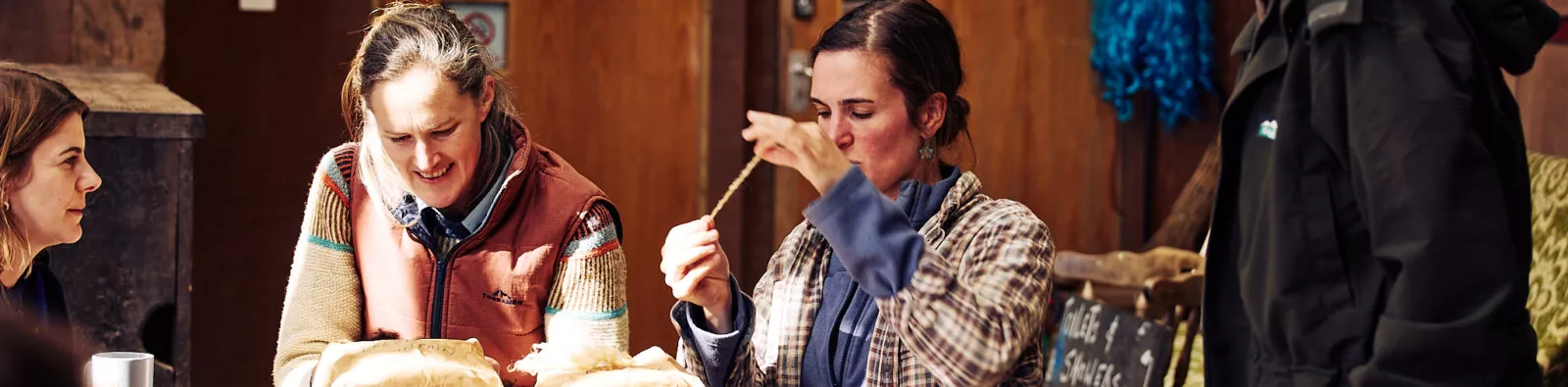
In early April, we gathered at Fernhill Farm for our first ORFC in the Field of 2026. Over 50 fibre farming enthusiasts came together for two days of hands-on learning of all things wool.
Farming with the Ancients
On a beautiful Easter Monday, ORFC in the Field at Fernhill Farm began as a small, excited group of wool-lovers came together, joined by a welcome surprise of spring sunshine.
What better way to land at Fernhill Farm than by an evening walk exploring the nearby landscape? In 1997, first-generation farmers Andy Wear and Jennifer Hunt bought a derelict 160 acre site on the top of the Mendip Hills National Landscape in Somerset. The history of the land at Fernhill, however, goes back much further.
Fernhill has been a watering hole and gathering point for 5000 years; the oldest human skeleton was found 5 miles away in Cheddar caves, and arrowheads and flint knappings have been found across Fernhill’s landscape. We enjoyed a walk to Ubley Warren at golden hour, hearing more about the myths, legends and archeological discoveries to which this corner of Somerset has been home – as well as the more recent history of lead mining and farming.
After a delicious agroecological meal prepared by Two Trees Catering – registered Workers Co-op and experts in regional, seasonal and foraged ingredients! – and a round of fireside knitting, we were well and truly immersed in the landscape of agroecological fibre farming, ready for tomorrow’s workshops.
Regenerative Fibre Farming in Action
Tuesday kicked off with a farm tour to dig deep into how modern day farmers Andy and Jen are stewarding the ancient land at Fernhill. Today, Andy and Jen look after 300 sheep and 50 cattle, as well as a number of woodland pigs and 10 acres of woodland, orchard and garden. An in-depth tour through the highlights of their 160 acres showcased just some of the regenerative grazing and land management practices they are employing, like maintaining sacrificial fields or creating habitat homes for protected species like doormice. ‘Feel free to dive into the sh*t everybody!’ exclaimed Andy, as he explained how cattle support the soil hummus. At Fernhill, problems become solutions: instead of draining, Andy and Jen planted 10000 willows and 20000 wetland plants to make the most of their wet system. No surprise, then, that Andy and Jen were nominated as soil farmers of the year!
Beyond the Land: Shearing, Dyeing and Breed Selection
Running a successful wool enterprise is not just about land management, we learn. Our farm tour ended with a mesmerising demonstration of blade shearing by Andy, who has been teaching this addictive and challenging skill for 25 years. We’ll let the pictures speak for themselves here!
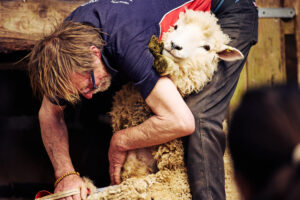
Credit: Jonathan Tomlinson
Over Tuesday and into Wednesday, the following workshops formed further stops in our tour through the world of fibre farming. Knitwear designer-maker Ria Burns demonstrated the multi-step process – including scouring, mordant, modifying, dyeing – involved when using natural dyes. We used a number of different natural dyes – onion skins (grown onsite in the polytunnel at Fernhill Farm), weld, coreopsis and madder root. We learnt that you can get a lot of different colours from wild plants – nettles, docks, hawthorn, willow – to name only a few!
With Tracy Wathen-Jones of the Rare Breeds Survival Trust, we understood more about selecting sheep breeds for conservation grazing and fleece. We explored how breed selection and management can shape environmental outcomes on the farm, and how all fleece has a use, it’s just about finding what it is!
And of course, fibre farming is not just about fleece, as we heard from Alice Robinson of British Pasture Leather, whose lunchtime talk dived deep into the process of working with the hides of Fernhill cattle.
Flocking Together: Wool in Community
In our final workshop, Deborah Barker, from South East England Fibre Shed, walked us through key steps to consider when developing a wool products business. Deborah began with emphasising the importance of having a values-led approach – working within agroecological values and considering animal welfare, environmental impact and livelihoods in a holistic way, but also determining your business’ specific values. Participants were encouraged to write down values their business would live by and not compromise on, as a starting point to approach business design.
‘There’s no limits to the number of products you can make from wool,’ Deborah told us, encouraging us to look beyond the saturated market of hand produced knitwear to other products like wool fertiliser pellets (which have the highest return of all wool products), chimney sheeps, garden mulch. There is no wrong wool, just the right wool for the right purpose!
Deborah’s final message was one that spoke to so much of what we had not only learnt but experienced over the last two days. She urged us to remember that you don’t have to do everything by yourself; joining groups like the spinners, weavers and dyer guild can be important to ensure you delegate and connect with others.
Industrialised fibre production has severed us from the people that farm, process, create and sell fabric, clothing and fibre products. But British wool is on a comeback as a solution to the pollution, traceability and human rights challenges fast fashion has caused. The so-called Great British Wool Revival serves to reconnect farmers, shearers, spinners, weavers and designers in a tight-knit (pun intended!) community working together to do fibre farming better.
Our two days at Fernhill have taught us the importance of collaboration – whether learning from one another in our afternoon crafting session, swapping dinner stories of our own farming journeys, or understanding the many steps (and people!) that must come together for beautiful finished wool products.
As such, wool is a microcosm of the larger agroecological farming world – a lens into the complex processes, skills and varied community needed to make change. ORFC in the Field at Fernhill reminded us of the potential we can achieve in alternative farming when we come together, learn and share. As they leave, one participant remarks, ‘I am planning to get Cotswolds in the next few months. I had been feeling nervous and like I didn’t know enough to go forward! I feel more confident now in my knowledge and ability to just go for it.’
We can’t wait to come together again at ORFC in the Field at Henbant for two days of permaculture, people and poultry workshops. See you there, ORFC Community!

Credit: Jonathan Tomlinson